
FISHTAIL PALM/ BHERLI MAAD
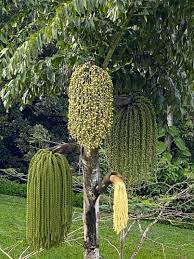
listen about me
Caryota urens
Scientific Classification
Kingdom: Plantae
Division: Magnoliophyta
Class: Liliopsida
Order: Arecales
Family: Arecaceae
Genus: Caryota
Species: urens
Scientific Name: Caryota urens L.
Common names –
English: Elephant’s palm, Toddy palm, Fish-tail palm, Indian sago
palm, Jaggery palm, Toddy palm, Sago/ Fish tail palm.
Hindi: Mari.
Marathi: Sur-maad, Bherli-maad.
Description:
1. Habit and Habitat: Palms up to 15 m tall. Evergreen forests, also in
the plains. Tall unbranched palm with persistent scars of leaf
bases.
2. Distribution: naturally found from sea level to 300 m, in Myanmar
(Burma),India, and Sri Lanka where it grows on plateau or in rain
forest clearings.
3. Morphology:
Leaf: compound, bipinnate, to 5 m long; pinnae 5-7 pairs, to 1.5 m
long, leaflets lamina 25 x 10 cm, cuneiform, apex premorse.
Inflorescence: spadix, shortly peduncled, much branched; spathes 3-5; spikelets closely arranged on the rachillae.
Flower: unisexual, Monoecious.
Fruit: Berry, stalked, ovoid or globose.
Seed: 1-2 seeded, ruminate.
Flowering and fruiting: January-April.
4. Propagation: through Seeds.
5. Importance:
From the pith a good variety of “sago” is obtained which is highly
nutritious. The fibers are manufactured into ropes, brushes,
brooms, baskets. Toddy is also obtained from this palm. Terminal
bud is edible. The sap extracted from the inflorescence of the plant
is used to make sugar and alcoholic beverages. The root is used for treating tooth ailments. The bark and seed are used to treat boils. It is used to make a wide range of products, but especially brooms, brushes, ropes, baskets etc.