
JAMAICAN CHERRY
listen about me
Muntingia calabura L.
Classification:
Kingdom: Plantae
Division: Angiospermae
Class: Equisetopsida
Order: Malvales
Family: Malvaceae
Genus: Muntingia
Species: calabura
Scientific Name: Muntingia calabura L.
Common Name-
English: Jamaica Cherry, Panama Cherry, Singapore Cherry, Strawberry tree, Jam tree, Cotton Candy berry, Calabura.
Marathi: Panchara, Chery
Description:
Habita & Habitat: Jamaica Cherry is a very fast-growing tree of slender proportions, reaching 25 to 40 ft. in height, with spreading, nearly horizontal branches.
Leaves: The leaves are evergreen, alternate, lanceolate or ovate, long-pointed at the apex, oblique at the base.
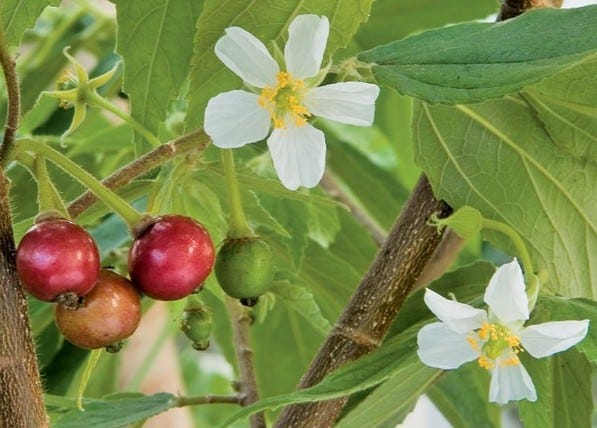
Flowers: The flowers with 5 green sepals and 5 white petals and many prominent yellow stamens last only one day, the petals falling in the afternoon. Flowers resemble strawberry bloom, hence the common name, Strawberry tree.
Fruits: The abundant fruits are round, 1-1.25 cm wide, with red or sometimes yellow, smooth, thin, tender s in and light-brown, soft, juicy pulp, with very sweet, musky,
somewhat fig-like flavor, filled with exceedingly minute, yellowish seeds, too fine to be noticed in eating.
Note: The tree has the reputation of thriving with no care in poor soils. It is drought- resistant but not salt-tolerant. Wherever it grows, fruits are borne nearly all year. The leaf
infusion is drunk as a tea-like beverage. Fruits contain hundreds of tiny seeds.
Uses:
1) M. calabura is planted as a source of timber and fuel. Its soft wood used for rural construction, while the bark is fibrous and used for making ropes.
2) The fruits are edible and in some cases sold in markets, as they can be eaten raw or processed as jam; leaves can be used for making tea. Also, traditional medicinal uses
have been reported for the leaves (headaches, prostate problems, reduce gastric ulcers), bark (antiseptic), flowers (antiseptic, reduce swelling, antispasmodic), and
fruits (respiratory problems; antidiarrheic).
3) It is said to help diabetic patients. A small reduction was recorded in patients blood sugar levels after consumption.
4) It is planted as an ornamental species, for shade, and also because the flowers are a source of nectar and pollen for the beekeeping industry.
5) The tree is also planted along river banks in Brazil, as fallen fruits attract fish.
6) M. calabura has a potential as a useful species for restoration of disturbed areas and stopping soil erosion. It also offers shelter for wildlife, as it is a source of food for
about 60 species of birds and mammals.