
ARJUN/ARJUN SADADA
listen about me
Terminalia arjuna (roxb.) wight. & arn.
Classification:
Kingdom: Plantae
Division: Angiospermae
Class: Magnoliopsida
Order: Myrtales
Family: Combretaceae
Genus: Terminalia
Species: arjuna
Scientific Name: Terminalia arjuna (Roxb.) Wight & Arn.
Common Name- English: Arjuna Tree
Hindi: Arjuna
Marathi: Arjun
Description:
Habit & Habitat- Arjun is a large deciduous tree with spreading crown and drooping branches. Its bark is thick, grey to pinkish green, smooth, thin, coming off in irregular
sheets. It attains a height of up to 35 m. The arjuna is seen across the Indian Subcontinent and usually found growing on river banks or near dry river beds in Uttar Pradesh, Bihar, Maharashtra, Madhya Pradesh, West Bengal, Odisha. It has also been
planted in Malaysia, Indonesia & Kenya.
Leaves: Leaves are usually sub-opposite, 10–15 cm long, and 4–7 cm broad; base is rounded or heart shaped, often unequal sided; veins are reticulate.
Flowers: Flowers are sessile and occur in simple or panicled spikes. Calyx is glabrous and has five short triangular lobes.
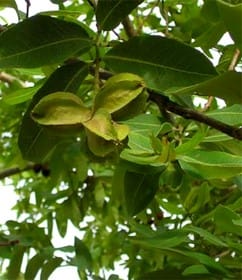
Fruits: Fruit is a fibrous-woody drupe, about 2.5–5 cm in size. It is dark brown when
mature and has five hard, projecting, veined wings. Flowering occurs from May to June, while fruits mature from January to March.
Uses: The bark of Arjun is astringent, sweet, acrid, cooling, aphrodisiac, urinary astringent, and expectorant, but, chiefly used as cardio tonic as it improves blood supply to heart. It is also useful in ulcer treatment, fractures, cirrhosis of liver,
ischaemic heart disease, and hypertension.