
UNDI
listen about me
Callophyllum inophyllum L.
Classification:
Kingdom: Plantae
Division: Angiospermae
Class: Dicotyledonae
Subclass: Polypetalae
Series: Thalamiflorae
Order: Guttiferales
Family: Guttiferae/Clusiaceae
Genus: Callophyllum
Species: inophyllum
Scientific Name: Callophyllum inophyllum L.
Plant Name Meaning: The tree was named Couroupita guianensis by the French botanist Jean Baptiste Christophore Fusée Aublet in 1775. The Latin specific epithet guianensis means “of the Guianas” (an area of north eastern South America)
Species: Couroupita guianensis Aub
Common Name-
English: Kokam, Goa butter tree, Kokum butter tree, Mangosteen
Hindi: कोकम Kokum
Marathi: भेरंड bheranda, भिरंड bhiranda, कोकंब kokamba, कोकंबी kokambi, रातंबा ratamba, रातंबी ratambi, तांबडा आंबा tambada amba
Tamil: murgal, murgal-mara
Kannada: ಮುರ್ಗಿನ ಹುಳಿ Murgina huli, ಪುನರ್ಪುಳಿ Punarpuli, Devana huli, ಮುರಗಲು Muragalu, ಮುಗಲ್, ಮುಗಲು Mugal
Konkani: भिरींड bhirind, कोकम kokam
Sanskrit: वृक्षामला Vrikshamia, Amlabija, Amlapura, Amlashaka
Description:
Calophyllum inophyllum is native to Africa in: Comoros; Kenya; Madagascar; Mauritius; Mozambique; Seychelles; Tanzania (including Pemba Island of the Zanzibar Archipelago); south, southeast and east Asia. This tree often grows in coastal regions, as well as nearby lowland forests.
However, it has also been cultivated successfully in inland areas at moderate altitudes. It tolerates varied kinds of soil, coastal sand, clay, or even degraded soil.
Description:
Habit, Habitat & Leaves: Calophyllum inophyllum is a low-branching and slow-growing tree, it spreads with a broad and irregular crown. It usually reaches 8 to 30 m (26 to 98 ft) in height. Its trunk is thick and covered with black and cracked bark.[11]
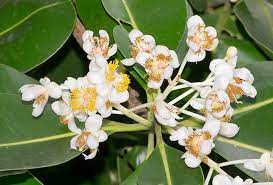
Flowers: Flowering can occur perennially, but usually two distinct flowering periods are observed twice a year, in late spring from April to June and in late autumn from October to December.[10]
The flower is 25 to 30 mm (0.98 to 1.18 in) wide and occurs in racemose or paniculate inflorescences consisting of four to 15 flowers. It has a sweet fragrance which attracts many insects to pollinate it.
Fruit– The fruit (the ballnut) is a round, green drupe measuring 2 to 4 cm (0.79 to 1.57 in) in diameter. When ripe, the fruit is wrinkled and its color varies from yellow to brownish-red. It has thin spongy flesh with a taste slightly like apple.
Uses: Shipbuilding- Mastwood is notable for its ability to grow to massive sizes in sandy or rocky beaches of island and coastal habitats, as well as its habit of sending out arching large trunks over the water where its seeds are dispersed via the currents.
Other Uses: Tamanu Oil extracted from the fruit kernels were important in Polynesian culture. The oils, as well as poultices made from leaves and flowers, are also commonly used for traditional medicine. The leaves contain compounds that are poisonous to fish and can be used as fish poison. The sap of the tree is poisonous and is used to make poison arrows in Samoa.
The mature fruit is poisonous enough to use as rat bait. The seeds yield a thick, dark green tamanu oil for medicinal use or hair grease. The nuts are dried before cracking, after which the oil-laden kernel is removed and further dried. The Mavilan, a Tulu -speaking tribe in north Kerala in India, use the bark to make a powder that they mix with water and apply to plants affected by a type of plant disease caused by water that they call neeru vembu.