KAILASHPATI/ CANNON BALL TREE
listen about me
Couroupita guianensis Aubl.
Classification:
Kingdom: Plantae
Division: Angiospermae
Class: Dicotyledonae
Subclass: Polypetalae
Series: Calyciflorae
Order: Lecythidales
Family: Lecythidaceae
Genus: Couroupita
Species: guianensis
Scientific Name: Couroupita guianensis Aubl.
Plant Name Meaning: The tree was named Couroupita guianensis by the French botanist Jean Baptiste Christophore Fusée Aublet in 1775. The Latin specific
epithet guianensis means "of the Guianas " (an area of north eastern South America)
Common Name-
English: Cannon Ball Tree.
Hindi: Nagalinga नागलिंग, Tope gola तोप गोला
Marathi: Kailashpati, Shivling, Shivalingam.
Description:
Habit & Habitat: Couroupita guianensis is a tree that reaches heights of up to 35 m (110 ft).
Leaves: The leaves, which occur in clusters at the ends of branches, are usually 8 to 31 centimeters (3 to 12 inches) long, but can reach lengths of up to 57 cm (22 in).
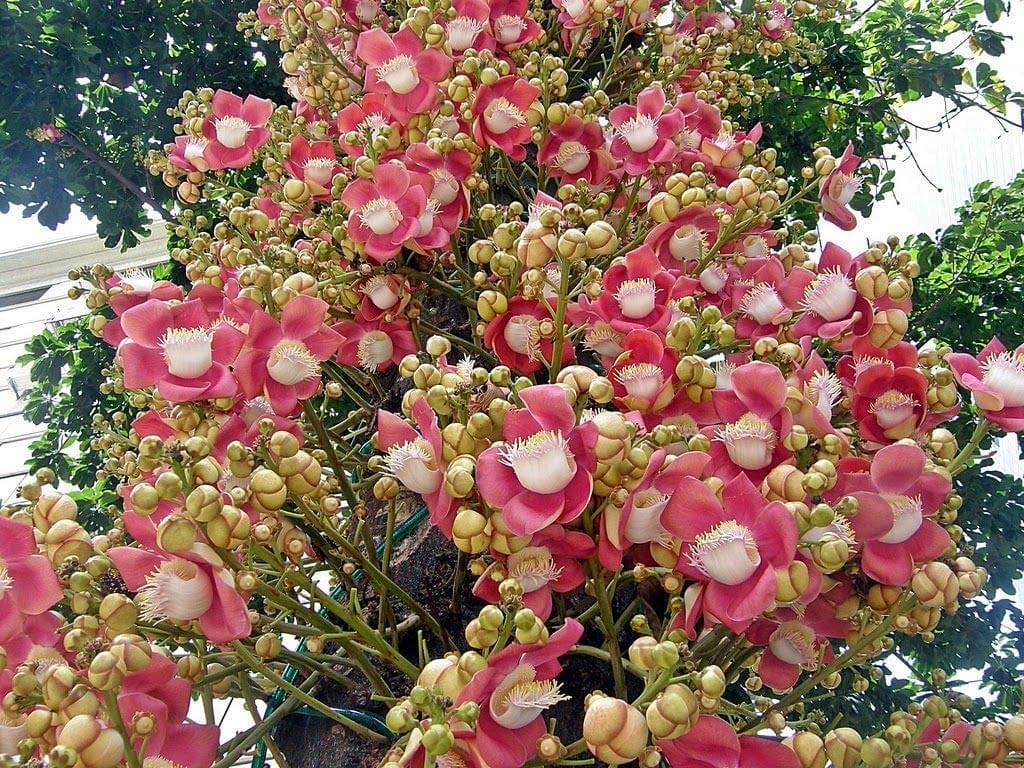
Flowers: The flowers are borne in racemes up to 80 cm (31 in) long formed directly from the trees trunk. They are considered an extreme example of cauliflory named flagelliflory. Some trees flower profusely until the entire trunk is covered with racemes. One tree can
hold as many as 1000 flowers per day.
The flowers are strongly scented, and are especially fragrant at night and in the early morning. They are up to 6 cm (2.4 in) in diameter, with six
petals, and are typically brightly colored, with the petals ranging from shades of pink and red near the bases to yellowish toward the tips. There are two areas of stamens: a ring of stamens at the center, and an arrangement of stamens that have been modified into a hood.
Fruits: The fruits are spherical with a woody shell and reach diameters of up to 25 cm (9.8 in), giving the species the common name "cannonball tree". Smaller fruits may contain about 65 seeds, while large ones can hold as many as 550. One tree can bear 150 fruits. The
fruits take up to a year to mature in most areas, sometimes as long as 18 months.
The fruit flesh is white and turns blue upon oxidation, a reaction with air.
Pollination: Although the flowers lack nectar, they are very attractive to bees, which come for the pollen.
The flowers produce two types of pollen: fertile pollen from the ring
stamens, and sterile pollen from the hood structure. The pollinators must work their way between the two areas of stamens as they gather the pollen. The carpenter bee Xylocopa
brasilianorum is a common pollinator.
Uses: Couroupita guianensis is planted as an ornamental for its showy, scented flowers, and
as a botanical specimen for its fruit.
The fruit is edible but is not usually eaten by people because, in contrast to its intensely fragrant flowers, it can have an unpleasant smell. It is fed to livestock such as pigs and
domestic fowl.
Parts of the plant have been used in traditional medicine. It has been used to treat hypertension, tumors, pain, and inflammation, the common cold, stomachache, skin conditions and wounds, malaria, and toothache, although data on its efficacy are lacking.
Cultural Significance: While the tree is not autochthonous to Asia, having only been introduced there in the last 300 years, its identity has been conflated with other trees
mentioned in Hindu and Buddhist scripture, especially the Sal tree. In India and Sri Lanka, the tree is venerated by Hindus, who believe its hooded flowers look like the Naga under
which the white stigma looks like a Lingam, and hence, it is grown at Shiva temples.
The cannonball tree has since then been planted at Buddhist and Hindu religious sites in Asia in the belief that it is the tree of sacred scriptures. In Sri Lanka, Thailand and other Theravada Buddhist countries it has been planted at Buddhist monasteries and other religious sites