
JAMBHUL
listen about me
Syzygium cuminii (L.) Skeels
Classification:
Kingdom: Plantae
Division: Angiospermae
Class: Dicotyledonae
Subclass: Polypetalae
Series: Calyciflorae
Order: Myrtales
Family: Myrtaceae
Genus: Syzygium
Species: cuminii
Scientific Name: Syzygium cuminii (L.) Skeels
Common Name-
English: Malabar plum, Java plum, Black plum, jamun, jaman, jambul, or jambolan
Hindi: Jamun
Marathi: Jambhul
Distribution: It is native to the Indian subcontinent and Southeast Asia,
including Myanmar, Sri Lanka, Bangladesh and the Andaman Islands
Description:
Habit & Habitat: As a rapidly growing species, it can reach heights of up to 30 m (100 ft) and can live more than 100 years.
Leaves: Its dense foliage provides shade and is grown just for its ornamental value. At the base of the tree, the bark is rough and dark grey, becoming lighter grey and smoother
higher up.
Stem: The wood is water resistant after being kiln-dried. Because of this, it is used in railway sleepers and to install motors in wells. It is sometimes used to make cheap
furniture and village dwellings, though it is relatively hard for carpentry.
The aromatic leaves are pinkish when young, changing to a leathery, glossy dark green with a yellow midrib as they mature. The leaves are used as food for livestock, as they have good
nutritional value.
Flowering: Syzygium cumini trees start flowering from March to April. The flowers are fragrant and small, about 5 mm (0.2 in) in diameter. The fruits develop by May or June and resemble large berries; the fruit of Syzygium species is described as drupaceous
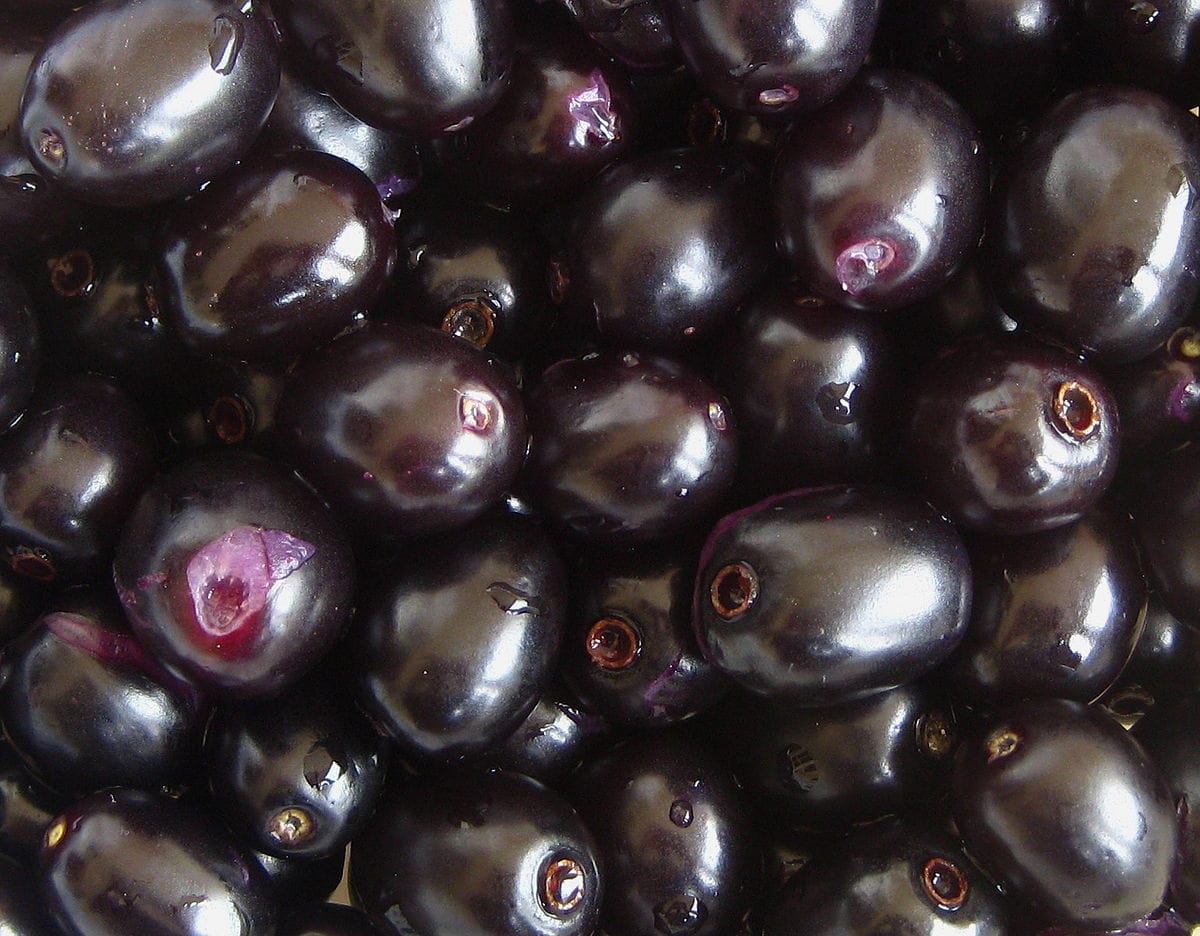
Fruits: The fruit is oblong, ovoid. Unripe fruit looks green. As it matures, its color changes
to pink, then to shining crimson red and finally to black color. A variant of the tree produces white coloured fruit.
The fruit has a combination of sweet, mildly sour and astringent flavour and tends to colour the tongue purple
Uses: The leaves are antibacterial, and are used for strengthning the teeth and gums. The fruit and seeds are sweet, acrid, sour, tonic, and cooling, and are used in diabities,
diarrhoea and ringworm. The bark is astringent, sweet sour, diuretic, digestive and anthelmintic.