
BHENDI/ PARAS PIMPAL
listen about me
Thespesia populnea Lam.
Classification:
Kingdom: Plantae
Division: Angiospermae
Class: Eudicots
Order: Malvales
Family: Malvaceae
Genus: Thespesia
Species: populnea
Scientific Name: Thespsia populnea (L.) Sol ex Correa
Common Name-
English: Portia Tree, Pacific Rosewood, Indian Tulip Tree, Milo
Hindi: पारोसा पिंपळ Parosa Pimpal.
Marathi: आष्ट Aashta, आस Aas, पारस भेंडी Paras-bhendi, पार्श्वपिंपळ Parshvapimpal.
Sanskrit: पार्श्वपिप्पल Parshwapippal
Distribution: It is native to tropical coastlines and is adapted for oceanic dispersal and
growth in island environment. As per IUCN Red List data it is native to the tropical America.
It became invasive species in many countries of tropical region. But in Hawai, it is used in
habitat restoration projects for the degraded tropical dry forests along with the native
species.
Description:
Habit & Habitat- A small tree growing in tropical coastline areas.
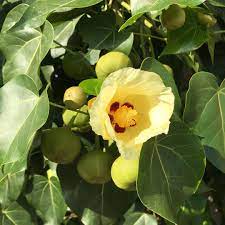
Leaves– Simple, 3-6 in. long, ovate, cordate, acuminate, entire, smooth, finely reticulately vained, sometime with minute peltate scales on both the surfaces.
Flowers– in axillary, solitary or racemose inflorescence.
Calyx- copular, truncate, covered with minute peltate scales.
Corolla– yellow with purple base, bigger in size, showy.
Gynoecium– 4-5 celled, with few ovules, style club shaped at the apex, 5 furrowed.
Fruit– globose, 1 in diameter, peltate hairy, surrounded by persistent calyx.
Uses: The heartwood of the Portia tree is dark reddish brown to chocolate brown. It is popular in Hawaii for woodworking for making bowls because of the range of colours expressed (tan, through yellow, to red). Traditionally it was planted in sacred groves and
used for religious sculpture.
Its bark is used to treat mouth infections among infants, and its wood is used to make canoes, house parts, and artwork. In South Asia, it is used to make a Carnatic musical instrument of South India.
The flower of the tree played a part in Sri Lanka’s independence movement. The wood from the tree was used by early Tamil people to make instruments in ancient Tamilakam.