
RAIN TREE/GULABI SHIRISH
listen about me
Albizia saman L.
Scientific Classification
Kingdom: Plantae
Division: Magnoliophyta
Class: Magnolipsida
Order: Fabales
Family: Fabaceae
Genus: Albizia
Species: saman
Scientific Name: Albizia saman (Jacq.) Merr.
Common names
English: Rain tree, Crow Bean tree; Monkey pod, Coco tamarind, East
Indian Walnut.
Hindi: Gulabi Siris, Vilaiti siris.
Marathi: Shirish, Guango.
Description:
1. Habit and Habitat: Large, fast-growing, deciduous tree of up to 25
m tall, it has a very wide umbrella-shaped crown. Native to dry
forests and savannahs of tropical Americas. Widely introduced as
landscape tree in tropical SE Asia and Hawaii.
2. Distribution: native to tropical South America but planted across
the tropics.
3. Morphology:
Leaf: Bipinnate, leaflets oval obtuse, oblique.
Inflorescence: Solitary globose heads.
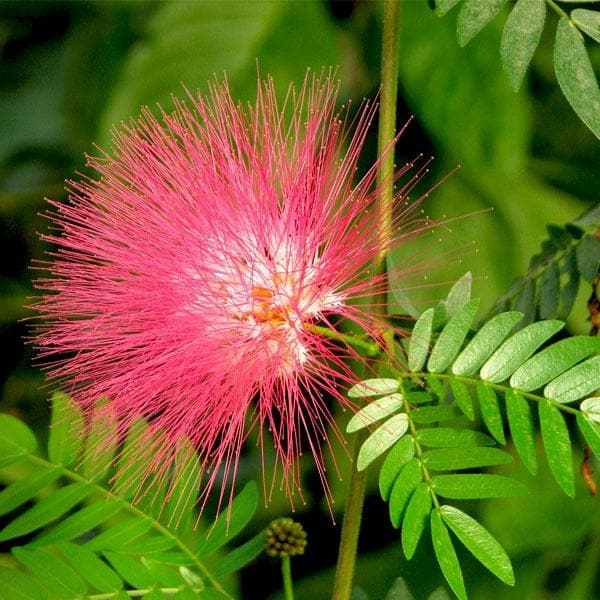
Flowers: The flowers of Albizia saman are grouped in axillary head.
The heads grow in racemes. The peduncle of the head is about 4-5
cm long.
4. Calyx: The calyx-tube is campanulate, shortly lobed, light green-coloured and tomentose.
5. Corolla: The corolla is composed of 5 pink-coloured and tomentose petals. The petals are oblong and connate at the base, about 6-8 mm long and 2 mm wide.
6. Androecium: The androecium is composed of numerous stamens.
The filaments are 2.5-3 cm long, connate at the base and pinkish at
the tip. The stamens have tiny and globose anthers.
7. Gynoecium: The style is 2.5-3 cm long with a simple stigma. The
ovary is about 5-6 mm long.
8. Fruit: The fruit is a fleshy pod, sweet to the taste and much relished by squirrels, horses and cattle.
9. Seeds: The seeds of Albizia saman are elliptic-oblong and
compressed. They are about 1 cm long and 0.5 cm wide and dark
brown-coloured. The seeds are embedded in the fruit pulp and
there are many seeds per pod.
Flowering and Fruiting time: March-October.
10. Propagation: Through seeds.
11. Importance:
a. Planted on roads as a very rapid growing shade tree and for its
attractive pink flowers.
b. Leaves and pods are used as fodder for cattle.
c. Due to the wood’s resistance to fungus and termites, the wood is
also used in making fine furniture.