
Ashoka
listen about me
Monoon longifolium Sonn. B Xue & R.M.K. Saunders
Scientific Classification
Class- Dicotyledoneae
Division- Polypetalae
Series- Thalamiflorae
Order- Ranales
Family- Magnoliaceae
Genus- Polyalthia
Species- longifolia
Common names
False Ashok, Indian Mast Tree, Indian Fir Tree, Ashoka
Description:
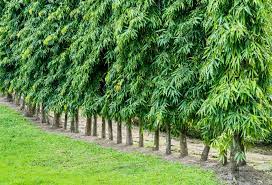
This false Ashoka tree was cultivated and gained popularity due to nostalgic reasons because it resembles the tall, harrow, Italian Cypress, which was used for ships masts. It does not required
pruning in order to maintain its height, straight, drooping branches.
Meanings- The name ‘Polyalthia’ is derived from a combination of Greek words meaning & many
cures& with reference to the medicinal properties of certain species and ‘longifolia’ meaning long leaves.
1) Description: The tree is evergreen and grows up to 80 ft. in height. The tree canopy is
straight with drooping branches.
Stem- The stem is elongated, canopy pyramidal, with thick corky bark.
Leaves– Leaves are simple, lanceolate, with wavy at margin, copper brown when young and
become dark green at maturity. It is a larval food plant of tailed jay butterfly.
Flowers– Flowering comes in spring. Tree covered with delicate star like pale green flowers.
Fruits- Fruits borne in clusters of 15-20, initially green and turning purple or black when ripe. These are eaten by birds such as Asian Koel, fruit bats.
Distribution: A native to India and Sri Lanka.
2) Uses- This tree is considered as best ornamental tree for cultivation in garden, avenue due to its height and canopy. The leaves are used for ornamental decoration during festival. The tree pruned to variable shapes to improve the focal point of garden. The wood is mostly used for manufacturing small articles such as pencils, boxes, matchsticks, etc.
Note– Nesting of Ashy Priniya, Thrush, Sunbirds have been found in the drooping branches.